In-Groups, Out-Groups, and Our Social Identity
It seems natural for us to accept various social roles throughout our lives, growing up we were all exposed to some sort of social role. When it comes to thinking about social roles it can be defined as a set of behaviors that are expected of someone who holds a particular status. For the sake of an example, when a women becomes a mother and has a child she occupies the status of mother and is also expected to play the role of the caring and loving mother towards her children.
However, role expectations differ between cultures and change over time. Not too long ago it was expected of mothers to stay at home with the children and tend to the house. But today while this still occurs it’s no longer a strict expectation and instead is an acceptable option. Because of this traditional social role is has created a link between women and the caring stay at home mother. At times it can be hard to separate a social role and an identity as most have simply been ingrained into our culture since we were born. This feeds into the social identity theory which was contributed by Henri Tajfel who defined it as a person’s sense of who they are based on their group memberships
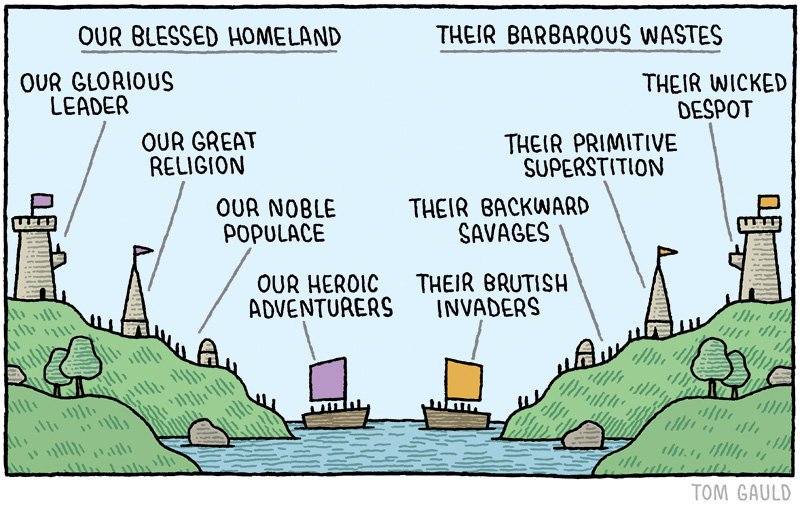
Belonging to a group is something we all seek, as when we belong somewhere it becomes an important source of pride and self-esteem. Traditionally the world has been divided into “us” and “them” though the process of putting people into social groups. Social categorization is known as establishing people into groups, in-groups (us) and out-groups (them). While engaging with a group you can identify with is crucial to our well-being, it also leads to prejudiced views between cultures that may result in racism.
In an article by The Root, it discusses the moral complications of the recent Marvel movie Black Panther. Telling the story of an oppressed group just looking for peace and acceptance for their people in a world where they don’t have control. It’s projected that they fall into the out-group, whereas the so called protectors of these people are the in-group. This complex turns hostile between groups because of how social roles of the black community in the film cursed them with a specific social identity of being lesser.
These tropes would lead you to believe this is all there is to this story, a simple right vs. wrong situation but it goes much further than that. The Root recalls real world incidents that Black Panther mirrors, back in 1992 during the Los Angeles riots where Rodney King was famously beaten to near death by police. Comparing it to the antagonist entire reasoning for his actions, being raised in a place being told they matter only to see the reality of the world on the outside (Briana L, 2018). It would drive almost anyone to do whatever they could to make a significant change.
Variety is the spice of life, and we should embrace differences before getting to a point where we subconsciously create in-groups and out-groups and turning our shared world into us vs. them. Media can serve as a casual reminder, showing examples of worlds where people turn on each other and while they are there for entertainment, taking a deeper look into the contexts behind events will help the world become a more tolerant place.
References: Briana, L. (2018). Can’t We All Just Get Along? Black Panther is Revisionist History
 Multiculturalism and the Media